
.png)
Vehicle Storage
Store Your Car, Motorcycle, & Other Vehicles
Finding a safe and convenient place to store your vehicle can be challenging—especially if you’re short on garage space or live in a community with HOA or street-parking restrictions. Leaving your vehicle exposed to harsh weather or sitting idle for long periods can also lead to rust, fading, and mechanical wear.
10 Federal Storage provides a smarter solution. With secure facilities, easy access, and flexible storage options, we make it simple to protect your car or motorcycle until you’re ready to hit the road again.
Whether you’re storing a car, motorcycle, or other personal vehicle, 10 Federal Storage offers secure, affordable, and flexible vehicle storage options to keep your ride safe and protected year-round. Our facilities are designed to handle everything from classic cars and daily drivers to sports bikes and seasonal vehicles, giving you peace of mind when your vehicle isn’t on the road.
Here's how to pick a space, what size you actually need, and how to prepare a vehicle so it starts when you come back for it.
Who Rents Vehicle Storage
The reasons cluster into a handful of familiar situations:
- Not enough driveway. Two-car household, three vehicles. A teenager's first car. A truck that doesn't fit alongside everything else.
- HOA and municipal parking rules. Plenty of neighborhoods restrict what can sit in a driveway or on the street, and how long it can sit there.
- Seasonal vehicles. A motorcycle through a northern winter, a convertible through a Texas summer, a project car that only comes out on weekends.
- Deployment and extended travel. Service members, contractors on long assignments, and anyone leaving the country for months who'd rather not sell the car.
- Collector and classic vehicles. Cars that shouldn't live outdoors and don't fit in the garage alongside daily drivers.
- Work vehicles. Vans, box trucks, and trailers that a residential street won't accommodate.
- Moving gaps. A second car with nowhere to go between a sale and a closing.
Storing an RV or a boat instead?
Those have different sizing math and very different preparation requirements. See RV and trailer storage or boat and watercraft storage.
Your Two Options
Outdoor Parking Spaces
An assigned space inside the gated lot. The most affordable way to store a vehicle, and the easiest to get in and out of.
- Lowest cost per vehicle
- No door dimensions to work around
- Easy in-and-out for frequent access
- Handles trucks, vans, and trailers
- Vehicle stays exposed to sun and weather
Drive-Up Enclosed Units
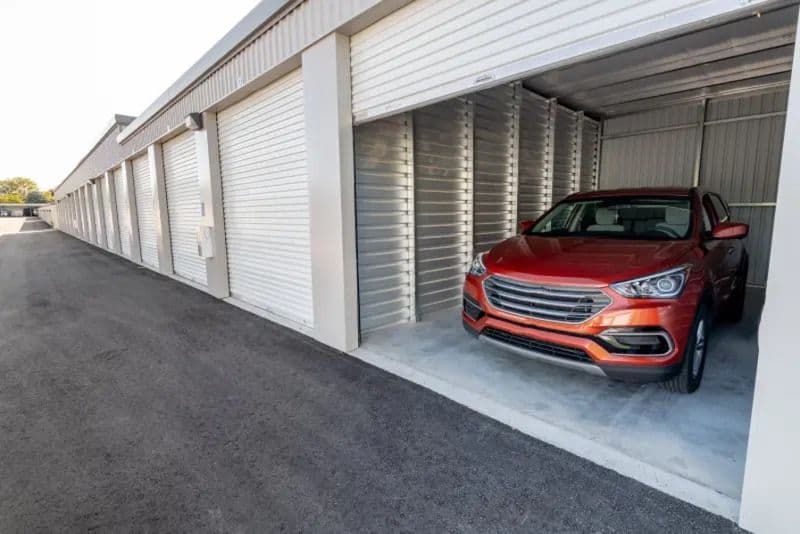
A standard storage unit with a roll-up door, sized to take a vehicle. Fully enclosed and out of direct sun and rain.
- Out of the weather and out of sight
- Room for parts, tools, and covers alongside
- Best fit for classics and motorcycles
- Door height and width limit what fits
- Higher cost than an outdoor space
For most daily drivers and second vehicles, an outdoor space is the sensible choice. Enclosed units earn their premium for motorcycles, classics, anything with paint you care about, and any vehicle sitting for a year or more.
Availability of parking spaces and vehicle-sized units varies by location.
What Size Do You Need?
Measure your vehicle's actual overall length — bumper to bumper, including anything that projects past them like a hitch, spare tire carrier, or ladder rack. Manufacturer specs are usually close but aftermarket additions aren't in them.
Then add about five feet. That buffer is what makes the difference between backing in comfortably and scraping a mirror every time you visit.
Vehicle | Typical length | Space or unit to look for |
|---|---|---|
Motorcycle or scooter | 6–8 ft | 5x10 enclosed unit. A 10x10 fits two comfortably with room for gear. |
Compact car | 14–15 ft | 10x15 enclosed, or a standard outdoor space |
Sedan or small SUV | 15–17 ft | 10x20 enclosed, or a standard outdoor space |
Full-size SUV or minivan | 17–18 ft | 10x20 enclosed at minimum, or an outdoor space |
Pickup, standard cab | 18–19 ft | 10x20 to 10x30, depending on bed length |
Pickup, crew cab and long bed | 20–23 ft | 10x30 enclosed, or a longer outdoor space |
Cargo or work van | 18–24 ft | 10x30, and check door height carefully for high-roof models |
Two vehicles together | — | 20x20 or larger |
Height is What Catches People Out
Length is the number everyone measures. Door height is the one that stops a rental at the entrance. Lifted trucks, high-roof vans, and anything with a roof rack, light bar, or cargo box need the door opening checked before you rent — not the unit's interior ceiling height, the door opening. Confirm clearance for the specific unit at the specific location. Our size guide covers unit dimensions in more detail.
Preparing a Car for Storage
How much of this applies depends on how long the vehicle is sitting. A month between moves needs almost none of it. Six months or more and skipping these steps is how people come back to a car that won't turn over, has flat-spotted tires, and smells like a mouse got in.
If it's sitting more than a month
- Wash and dry it first. Bird droppings, tree sap, and road salt etch paint the longer they sit. This matters more for outdoor storage, and it matters a lot in winter after salted roads.
- Fill the fuel tank and add stabilizer. Fuel degrades over months, and a full tank leaves less air space for condensation. Add stabilizer before the final drive so it circulates through the system.
- Change the oil. Used oil carries acidic combustion byproducts that sit against engine internals the whole time the car is parked. Fresh oil before a long sit is cheap insurance.
- Inflate tires to the upper end of spec. Slightly over-inflating reduces flat-spotting, since tires lose pressure gradually while parked.
- Deal with the battery. A car battery will discharge over a few months of sitting. Disconnecting the negative terminal is the simple approach. A battery tender is better, but units aren't powered — so disconnecting is usually the practical option here.
- Release the parking brake. Brake pads left clamped against rotors for months can bond to them. Use wheel chocks instead.
- Clear out food, wrappers, and trash. The single most common cause of a rodent problem in a stored car.
- Close the windows and vents. And plug the exhaust tip with steel wool if pests are a concern in your area.
- Use a breathable cover. A proper car cover, not a tarp. Tarps trap moisture against paint and the grommets scratch.
Storing a Motorcycle
- Fuel stabilizer and a full tank, same as a car
- Battery disconnected or removed entirely
- Tires inflated to spec, and on a stand if you have one, to keep weight off them
- Chain cleaned and lubricated before it sits
- Cover the exhaust openings against pests
- Cover the bike with something breathable
A 5x10 unit fits most bikes with room for a helmet, gear, and a stand. It's one of the cheaper units in the lineup and it's the most common motorcycle storage setup we see.
What You'll Need to Rent
Vehicle storage carries a few requirements that a regular storage unit doesn't:
- Current registration. The vehicle must be currently registered, and you'll need to provide proof of registration.
- Proof of insurance. The vehicle must be insured, and you'll need to provide proof of coverage.
- The vehicle must be operable. Vehicles that can't be driven or towed out create real problems at move-out.
- No leaking fluids. A vehicle dripping oil, coolant, or fuel isn't suitable for storage in a shared facility.
- No maintenance, repairs, or washing on site. Facilities aren't set up for fluid disposal, and there's no on-site staff to supervise work.
- One party per rental. Each space or unit is leased to exactly one party, who holds the access credentials and remains responsible for what's stored.
Insurance is worth a phone call before you rent
A protection plan is required at checkout for every rental, and it has a coverage ceiling. Vehicles are commonly excluded from storage protection plans on the reasoning that they're covered by an auto policy — but some auto policies reduce or suspend coverage for a vehicle in long-term storage. Ask your insurer specifically what applies while the vehicle is parked and not driven.
Why an Automated Facility Works for Vehicle Storage
10 Federal Storage has no rental office and no staff on site. Everything runs online. For someone storing a vehicle, that turns out to matter more than it does for a unit full of boxes:
- Nearly all locations offer 24/7 gate access. If you want the bike out at 6am on a Saturday for a ride, or you're getting back from a trip at 11pm and need to drop the car, there's no office schedule in the way.
- You can rent at any hour. Pick the space, sign the lease, get your gate code. No appointment, no waiting for Monday.
- Month-to-month. Store a motorcycle for five winter months and stop. No annual commitment.
- Wide drive aisles. Facilities are laid out so you can maneuver a truck or a trailer without a spotter — useful, since there's no one on site to be one.
- Support is remote. Our customer support team handles questions by phone and online rather than from a desk at the property.
Our facilities are built for accessibility—so whether you’re storing your motorcycle for the winter, parking an extra car between moves, or preserving a classic collectible, you can trust that it’s stored safely and conveniently.
Vehicle Storage FAQs
Most sedans and small SUVs fit a 10x20 enclosed unit. Compact cars can work in a 10x15. Full-size pickups usually need a 10x30. Measure your vehicle's overall length including anything projecting past the bumpers, then add about five feet for maneuvering room.
It is required that stored vehicles to be operable and free of fluid leaks, because a vehicle that can't be moved creates significant problems at the end of a lease.
A protection plan is required at checkout for all rentals. Separately, you should confirm with your auto insurer what coverage applies to a vehicle in long-term storage — some policies change coverage for a vehicle that isn't being driven, and storage protection plans commonly exclude vehicles.
No. Maintenance, repairs, oil changes, and washing aren't permitted at our facilities. There's no fluid disposal on site and no staff to supervise the work.
Outdoor parking is more affordable and easier to access, and it's fine for daily drivers, work vehicles, and second cars. An enclosed unit is worth the premium for motorcycles, classic and collector vehicles, anything with paint you're protecting, and any vehicle sitting longer than about a year.
Nearly all our locations offer 24/7 gate access, so you can reach your vehicle on your own schedule rather than during office hours. There's no office at our facilities.
Disconnect the negative terminal before you leave it. Our units aren't powered, so a battery tender isn't an option inside a unit. If the vehicle will sit longer than a few months, removing the battery entirely and keeping it somewhere you can maintain it is the better approach.
Yes, but a proper breathable car cover rather than a tarp. Tarps trap moisture against the paint and their grommets and edges can scratch the finish as they shift in wind.
Yes, subject to space availability at the location. Larger work vehicles usually need a 10x30 or an outdoor space. If you're storing a high-roof van in an enclosed unit, check the door opening height before renting rather than the unit's interior height.
It varies substantially by market, space type, and size — outdoor parking is consistently the most affordable option and enclosed units cost more. Current pricing and any available move-in offers are shown live for each space on our facility finder.
Find Vehicle Storage Near You
Ready to protect your car, motorcycle, or other vehicle? Find a 10 Federal Storage facility near you, reserve your space online, and enjoy the confidence of knowing your vehicle is in good hands with a trusted storage provider.