
.png)
RV Storage
Self Storage For Your RVs and Trailers
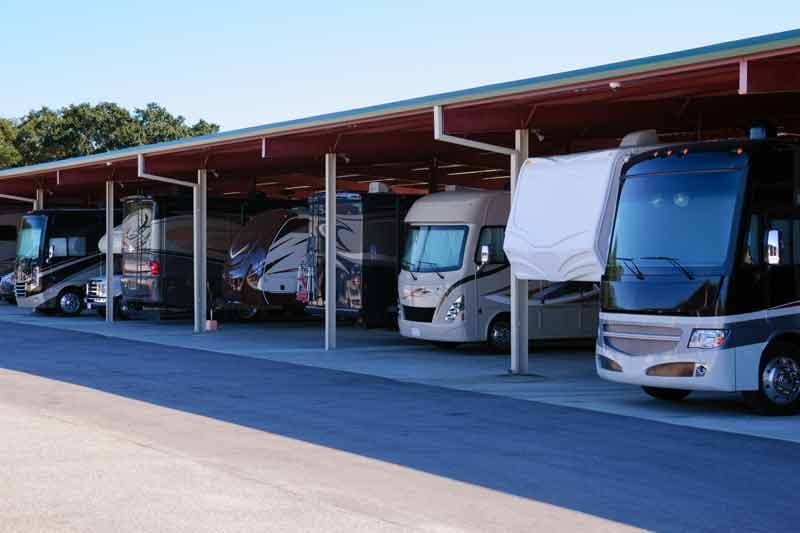
RV and Trailer Storage
Owning an RV or trailer opens the door to endless possibilities for travel and exploration, but it also comes with one big question: where do you keep it when you’re not on the road? Many neighborhoods and HOAs have strict rules against parking large vehicles in driveways or streets, and even if you can, doing so often exposes your RV to harsh weather and potential damage.
That’s where 10 Federal Storage comes in. Our dedicated RV and trailer storage spaces give you a reliable, off-site option to keep your vehicle safe, secure, and out of the way—while still being easy to access whenever you’re ready for your next trip.
An RV spends most of the year parked. Where it parks — and how you leave it — determines whether next season starts with a road trip or with a repair bill. Here's how to size a space, what to do before you walk away from it, and what our facilities can and can't do for you.
Why RV Owners Store Off-Site
Most people don't set out to rent RV storage. They run into one of these:
- The HOA letter. A great many communities prohibit recreational vehicles in driveways or on the street, sometimes with a limit measured in hours.
- Municipal ordinances. Plenty of cities restrict RV parking on residential streets independently of any HOA.
- It doesn't fit. A 32-foot travel trailer occupies most of a suburban driveway and blocks the garage.
- Sightlines and neighbors. Even where it's permitted, a fifth wheel parked out front is a recurring conversation.
- Security. A gated lot with cameras and coded entry beats a street parking spot.
- Seasonality. In northern markets an RV is genuinely unusable for four to six months of the year, and paying to store it beats surrendering the driveway.
Storage Options to Fit Your Vehicle
Every vehicle is different, and we offer multiple storage types to fit your needs:
- Outdoor Parking Spaces: Perfect for large RVs, travel trailers, fifth wheels, or campers. These open spaces make maneuvering easy and are ideal for short- or long-term parking.
- Covered Parking (at select locations): Provides additional protection from the elements such as rain, snow, and UV rays.
- Drive-Up Storage Units: Great for smaller trailers, pop-up campers, or personal gear that needs to be kept enclosed and secure.
Whether you need a 20-foot, 30-foot, or 40-foot parking space, our facilities have flexible options to accommodate a variety of vehicle sizes.
Sizing a Space for Your RV
Get this measurement right and the rest is straightforward. Get it wrong and you'll be rebooking.
Measure the full overall length, not the model number. A "28-foot" travel trailer is describing box length. Actual bumper-to-coupler length is usually two to four feet longer once you count the tongue, the propane tanks on the A-frame, and the spare tire or bike rack on the back. Measure from the furthest forward point to the furthest rearward point.
Then add five feet. You need room to swing the tongue while backing in without contacting the vehicle in the next space.
RV type | Typical overall length | Space to look for |
|---|---|---|
Teardrop / pop-up camper | 10–18 ft | 20 ft. Small pop-ups may fit a 10x20 enclosed unit — check collapsed height. |
Class B camper van | 17–23 ft | 25–30 ft. The one RV class that sometimes fits an enclosed unit. |
Small travel trailer | 16–24 ft | 25–30 ft |
Class C motorhome | 20–33 ft | 30–40 ft |
Large travel trailer | 24–35 ft | 30–40 ft |
Fifth wheel | 25–45 ft | 35–50 ft. Measure to the front of the kingpin overhang. |
Class A motorhome | 26–45 ft | 35–50 ft |
Utility or cargo trailer | 8–24 ft | Varies. Smaller enclosed trailers often fit a 10x20 or 10x30 unit. |
Available space lengths vary by location.
Two other measurements worth taking
- Width with slides in and awning mounted. Slide-outs retract, but awning rails, mirrors, and ladder racks don't.
- Height including the air conditioner. Rooftop AC units, satellite domes, and vent covers add a foot or more above the roofline. This matters for gate clearance and for any covered structure, not just enclosed units.
Before You Store It: The Winterizing Checklist
An outdoor space doesn't protect against freezing
This is worth saying plainly, because it's where expensive mistakes happen. Storing your RV in a gated lot protects it from theft and gets it off your driveway. It does not keep the plumbing above freezing. If your RV will sit through freezing weather, it needs to be winterized properly regardless of where it's parked.
Water system
- Drain the fresh water tank, the water heater, and every line. Open low-point drains and leave faucets open.
- Bypass the water heater before adding antifreeze, or you'll waste six gallons of it filling a tank you just drained.
- Pump RV antifreeze through every line until it runs pink at each faucet, including the outdoor shower and the toilet valve. Use RV-specific antifreeze, never automotive.
- Pour antifreeze into every drain trap — sinks, shower, and toilet.
Holding tanks
- Empty and flush black and grey tanks completely before you arrive. Our facilities have no dump station and no waste disposal of any kind. Tanks must be emptied at a dump station, campground, or RV service facility before you bring the vehicle in.
- Rinse until the water runs clear, then add antifreeze to the tanks.
- Leave the valves closed so nothing dries out in the gate seals.
Engine, fuel, and battery
- Fill the fuel tank and add stabilizer, then run the engine long enough to circulate it. A full tank leaves less room for condensation.
- Change the oil before a long sit rather than after. Used oil is acidic and sits against internals the whole time.
- Run the generator under load for a while, then treat its fuel the same way.
- Disconnect or remove the batteries. Our units and parking spaces are not powered, so a trickle charger isn't an option on site. Removing house and chassis batteries and keeping them somewhere you can maintain them is the reliable approach — a discharged deep-cycle battery left through a winter often doesn't come back.
- Turn off the propane at the tank and cover the regulator.
Tires, seals, and pests
- Inflate tires to the maximum sidewall pressure and cover them. UV is harder on RV tires than mileage is — most are replaced for age, not tread wear.
- Get weight off the tires if you can, using leveling jacks or blocks, to reduce flat-spotting on long sits.
- Inspect and reseal roof seams before storage, not after. A seam that's marginal in October will be a leak by March.
- Remove all food, including sealed and canned goods. This is the number one cause of a rodent problem in a stored RV.
- Block entry points — steel wool in gaps around plumbing and wiring penetrations, and covers over exhaust and vent openings.
- Prop the refrigerator and freezer doors open after cleaning them out.
- Close blinds and curtains to keep sun off the upholstery and dash.
If you're using a cover
Use a proper RV cover, not a tarp. Tarps trap moisture against the sidewalls and their grommets and edges will chafe through gelcoat and decals over a season of wind. A fitted breathable cover is a genuine upgrade; a blue tarp is usually worse than nothing.
What You'll Need to Rent
- Current registration for the RV or trailer. Proof of current registration is required.
- Proof of insurance. The RV or trailer must be insured, and you'll need to provide proof of coverage.
- No fluid leaks. A vehicle dripping oil, coolant, or fuel isn't suitable for a shared lot.
- Motorized RVs must be operable. Towables — travel trailers, fifth wheels, pop-ups, and utility trailers — don't need to be operable, since they don't run under their own power.
- One party per rental. Each space is leased to exactly one party, who holds the access credentials and remains responsible for the vehicle stored there.
What Our Facilities Don't Offer
Being direct here saves a wasted trip:
- No dump station. There's no waste disposal on site. Empty your tanks before you arrive.
- No shore power or electrical hookups. You can't plug in, charge, or run anything at your space.
- No water hookup for washing. Washing and detailing aren't permitted at our facilities.
- No maintenance or repairs on site. No oil changes, no fluid disposal, no service work.
- No living or sleeping in a stored RV. Storage facilities aren't campgrounds and overnight occupancy isn't permitted.
- No staff to help you back in. Our facilities are unstaffed. Drive aisles are laid out wide enough to maneuver a large rig without a spotter, but there's nobody on site to be one.
Why an Automated Facility Suits RV Storage
10 Federal Storage runs with no rental office and no on-site staff. For RV owners specifically:
- Nearly all locations offer 24/7 gate access. Departures happen at 5am and arrivals happen at midnight. Neither works at a facility with office hours.
- Rent online at any hour — including the evening you get the HOA letter.
- Month-to-month terms. Store from October through April and stop. You're not carrying a space through the season you're actually using the RV.
- Wide drive aisles sized for maneuvering large vehicles and trailers.
- Support is remote, handled by our customer support team by phone and online.
Storing a tow vehicle or a boat too?
Keeping everything at one facility means one gate code and one trip when you're prepping for a season. See vehicle storage for trucks and cars, or boat storage for watercraft.
RV Storage FAQs
Measure the full overall length from the furthest forward point to the furthest rearward point — including the tongue, propane tanks, and any rear-mounted rack — then add about five feet for maneuvering. Model names describe box length, not overall length, and are usually two to four feet short.
No. Our facilities have no dump station and no waste disposal. Black and grey tanks need to be emptied and flushed at a dump station, campground, or RV service facility before you bring the vehicle to storage.
No. Our parking spaces and units aren't powered, so there's no shore power or trickle charging available. For long-term storage, disconnecting or removing the batteries and maintaining them off-site is the reliable approach.
Yes, if it will sit through freezing weather. An outdoor parking space protects against theft and gets the RV off your property, but it doesn't keep plumbing above freezing. Winterize exactly as you would at home.
No. Overnight occupancy isn't permitted. Storage facilities aren't campgrounds and have no hookups, water, or waste disposal.
No. Washing, detailing, maintenance, and repairs aren't permitted at our facilities. There's no water hookup for washing and no fluid disposal on site.
Yes. Trailers and fifth wheels are stored unhitched in their assigned space. You'll want wheel chocks and, for a fifth wheel, appropriate support under the kingpin.
Proof of insurance is required to store an RV or trailer with us, so you'll already have a policy in place. What that policy actually covers during storage is worth checking separately — many RV policies have a specific storage provision, and some reduce coverage when the vehicle isn't in use. Note also that the protection plan required at checkout carries a coverage ceiling well below the value of most RVs, so it isn't a substitute for your own policy.
Every four to six weeks is a reasonable rhythm for a long sit. Look for new roof leaks, signs of pests, tire pressure loss, and anything shifting. Catching a seam leak in month two rather than month six is the difference between a tube of sealant and a floor repair.
Yes. Utility, cargo, and boat trailers can be stored in parking spaces, and smaller enclosed trailers sometimes fit in a 10x20 or 10x30 unit. For watercraft specifically, our boat storage page covers preparation in more detail.
Find RV and Trailer Storage Near You
Ready to store your RV, camper, or trailer with confidence? Find a 10 Federal Storage location near you, reserve your space online, and enjoy the peace of mind that comes with professional storage and trusted protection.